The Story Behind the Cartier Baignoire: From 1958 to Modern Revival
Explore the legacy of the Cartier Baignoire from its 1958 debut to the 2026 Watches and Wonders revival featuring the iconic Clou de Paris motif across case, dial, and bangle.
The Legacy of the Cartier Baignoire
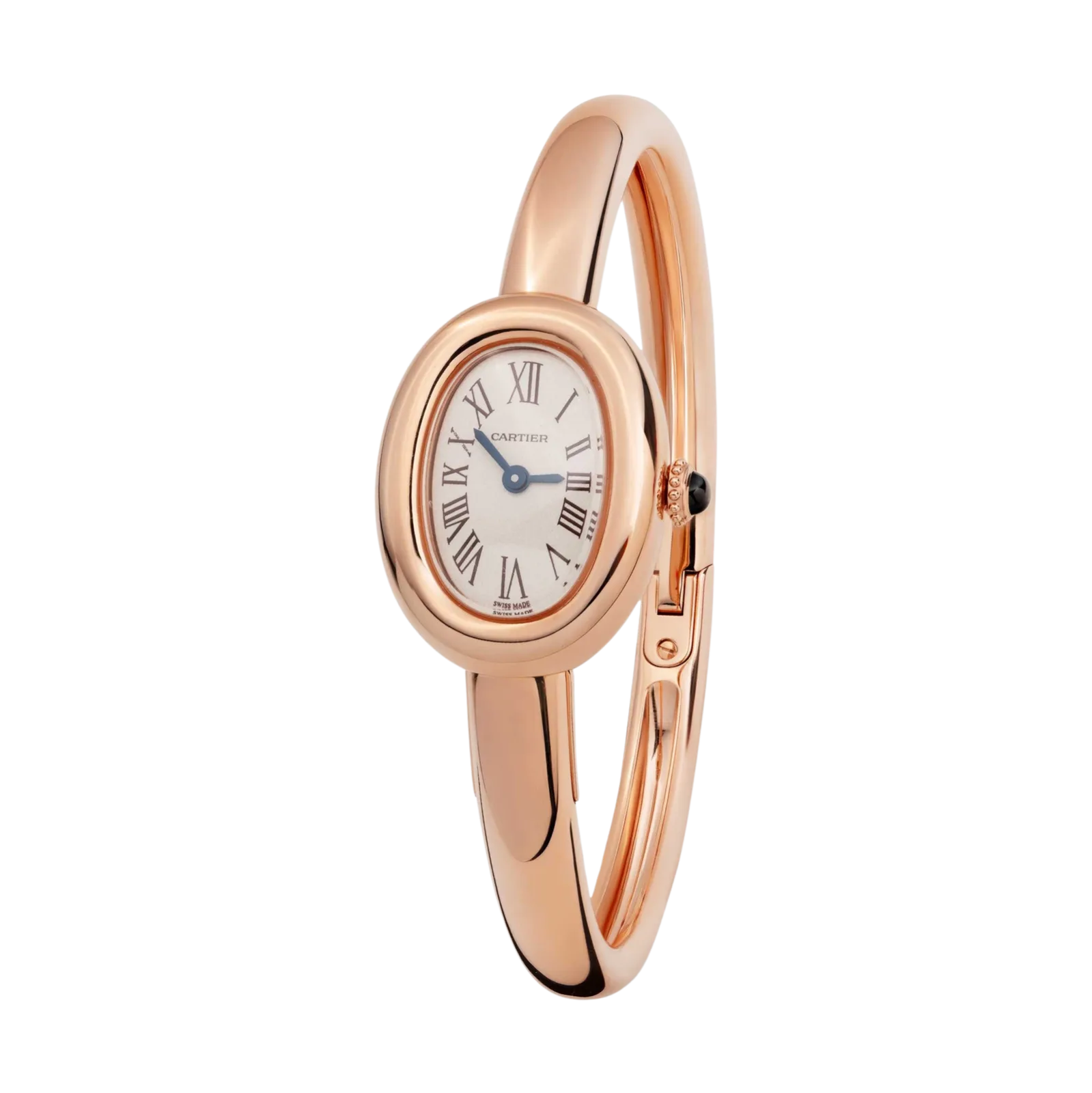
The Cartier Baignoire is one of the most distinctive timepieces in the Maison’s heritage, first introduced in 1958 and officially named in 1973. Its name—derived from the French word for 'bathtub'—refers to its elongated oval shape, a design that has remained a hallmark of elegance and femininity throughout its history. Originally conceived as a jewellery watch, the Baignoire was crafted with precision and artistry, blending horology with high jewellery traditions.
In 2023, Cartier reintroduced the Baignoire with a bangle bracelet edition, marking a modern reinterpretation of the classic silhouette. This evolution culminated at Watches and Wonders 2026 with a full-scale revival that reimagines the entire piece through the lens of one of Cartier’s most enduring decorative motifs: Clou de Paris.
The 2026 Clou de Paris Revival
At Watches and Wonders 2026, Cartier unveiled a new version of the Baignoire adorned entirely with the Clou de Paris motif—a pyramidal hobnail pattern that has been part of the brand’s stylistic vocabulary since the early 1920s. This intricate design element, known for its tactile depth and visual richness, now covers every surface of the watch: from the bangle to the case to the dial.
The motif is rendered in monochrome yellow gold to ensure visual continuity across the entire piece. Craftsmen carefully adjusted the proportions of the Clou de Paris pattern to follow the oval curves of the Baignoire’s silhouette, maintaining harmony between form and decoration. Even the yellow gold push-buttons on the clasp are designed to blend seamlessly into the bracelet line, reinforcing the watch’s sculptural unity.
The final polishing stage is carried out entirely by hand, a meticulous process that demands precision to preserve and accentuate the relief of each pyramid-shaped element. This attention to detail underscores Cartier’s commitment to treating watchmaking and jewellery as one discipline.
Design Details of the 2026 Baignoire Collection
The 2026 Baignoire lineup includes two bangle versions and three strap references, each showcasing different interpretations of the Clou de Paris theme.
Bangle Models
The collection launches with two bangle editions:
- **Yellow Gold Model**: Features a golden dial and is available in sizes 15, 16, and 17. It measures 24.6 x 19.3 mm and has a thickness of 7.5 mm.
- **Ultra-Precious Diamond Edition**: The case and bangle are set with 171 brilliant-cut diamonds (4.70 ct), while the dial features 100 brilliant-cut diamonds (0.46 ct) in a snow setting. Available in sizes 15 and 16, this version uses an inverted setting on the case to create a layered interplay between the diamonds and the Clou de Paris relief.
Both bangle models are powered by a quartz movement and are water-resistant to 3 bar.
Strap Models
Three additional strap references complete the lineup:
- A yellow gold model with a diamond-set dial (100 brilliant-cut diamonds, 0.46 ct) on a black patent calfskin strap (24.6 x 18.7 mm, 7.2 mm thick).
- A larger yellow gold model with a grained silvered dial on a shiny black alligator strap (36 x 26 mm, 8.6 mm thick), fitted with a high-autonomy quartz movement.
- A yellow gold model with a black lacquered dial on a shiny black alligator strap (31.4 x 23.1 mm, 7.3 mm thick).
All strap versions are also quartz-powered and water-resistant to 3 bar.
Craftsmanship and Heritage
The Clou de Paris motif has long been associated with Cartier’s legacy of fine craftsmanship. First appearing in the early 1920s, it has been used across jewellery, watches, and even furniture, symbolizing both luxury and technical mastery. Applying this pattern to the Baignoire required specialized techniques to mould gold while preserving the evenness of the pyramidal shapes.
The use of monochrome yellow gold ensures that the motif remains cohesive across the watch’s surfaces. The hand-polishing process further enhances the three-dimensional quality of the design, making each piece unique in its finish and depth.
This revival reflects Cartier’s ongoing dedication to innovation within tradition. By revisiting a historic design language and applying it to a modern context, the brand reaffirms its position at the intersection of art, craft, and timekeeping.
Frequently Asked Questions
What is the significance of the Clou de Paris motif on the 2026 Baignoire?
The Clou de Paris motif, meaning 'Parisian nail,' is a signature decorative pattern in Cartier’s design vocabulary since the 1920s. On the 2026 Baignoire, it is applied across the entire watch—case, dial, and bangle—to create a unified, sculptural aesthetic that emphasizes texture and craftsmanship.
How does the diamond-set Baignoire differ from the standard yellow gold version?
The diamond-set Baignoire features 171 brilliant-cut diamonds (4.70 ct) on the case and bangle, and 100 diamonds (0.46 ct) on the dial in a snow setting. It also uses an inverted setting on the case to enhance the interplay between the diamonds and the Clou de Paris relief, creating a layered visual effect not present in the plain yellow gold model.
Is the 2026 Baignoire available in rose gold?
The 2026 Baignoire collection features yellow gold models. While a separate listing exists for a Cartier Baignoire in 18K rose gold (reference WGBA0080), it is not part of the Clou de Paris revival and may be a different configuration. The Clou de Paris edition specifically highlights yellow gold.
What movement powers the 2026 Baignoire models?
All Baignoire models in the 2026 collection are powered by a quartz movement. The bangle versions have a standard quartz caliber, while the larger strap model features a high-autonomy quartz movement for extended battery life.
Are the Baignoire bangle models water-resistant?
Yes, both bangle versions of the 2026 Baignoire are water-resistant to 3 bar, equivalent to approximately 30 meters. This makes them suitable for everyday wear but not for swimming or diving.
When was the Cartier Baignoire first introduced?
The Cartier Baignoire was first introduced in 1958 and officially named in 1973. It has since become one of the brand’s most iconic shaped watches, celebrated for its elegant oval form and status as a jewellery timepiece.