How to Spot a Genuine Tiffany & Co. Return to Tiffany Necklace vs. a Counterfeit
Learn how to identify a genuine Tiffany & Co. Return to Tiffany necklace by checking heart tag engraving, signature plaque, chain quality, and more. Avoid counterfeit jewelry with this expert guide.
How to Spot a Genuine Tiffany & Co. Return to Tiffany Necklace vs. a Counterfeit
The Tiffany & Co. Return to Tiffany necklace is one of the brand’s most iconic and widely copied pieces. Its recognizable heart-shaped pendant and toggle clasp make it a popular choice for both authentic buyers and counterfeiters. While modern fakes can appear nearly identical at first glance, key differences in engraving, construction, and materials reveal their true nature under close inspection. This guide outlines the definitive checkpoints to distinguish an authentic Return to Tiffany necklace from a counterfeit.
Heart Tag Engraving: The Most Critical Indicator
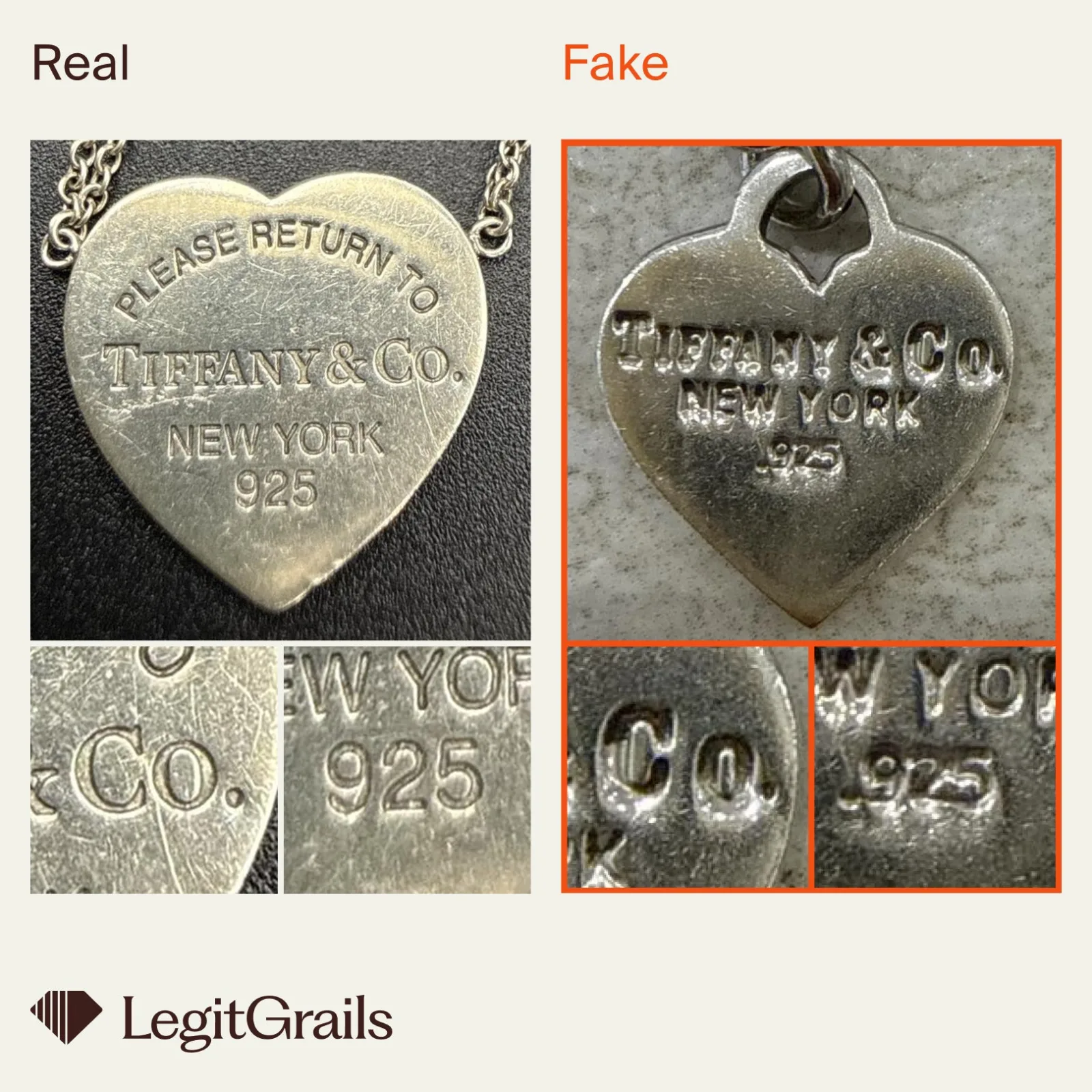
The heart-shaped pendant is the centerpiece of the Return to Tiffany design, and its engraving is the most reliable authentication point. A genuine piece features four distinct lines of text: a curved line arcing along the top edge of the heart, followed by three centered lines of text below it.
- **Authentic**: The top curved line follows the contour of the heart with consistent spacing. The three lines beneath are perfectly aligned on a straight baseline, vertically centered, and evenly spaced. Each character has uniform stroke depth and sharp interior corners.
- **Counterfeit**: The curved line is often missing entirely. The three lines are typically set too high, tilted downward to the right, and each line may be centered on a different axis. Stroke depth varies dramatically—some letters are nearly invisible while others are gouged deeply.
Additionally, the terminal period after 'Tiffany' on an authentic tag appears as a separate, round dot. On counterfeits, it is often merged into the adjacent letter or absent altogether.
Signature Plaque on the Chain: Margin Matters
Located on the chain, the oval signature plaque bears the wordmark inside a recessed well. This detail is crucial for verification.
- **Authentic**: The engraved letters sit clearly within the recess, leaving visible margins at both ends. Each character is separated by a clean valley, and the copyright symbol (a ring enclosing a letter) is open and legible.
- **Counterfeit**: The lettering fills the entire recess, touching both edges and merging into one another. The copyright ring is often filled in, appearing as a solid blob. There is no terminal period at the end of the wordmark.
This margin difference is subtle but decisive. Always examine both ends of the plaque simultaneously to confirm spacing consistency.
Chain and Bail Construction: Precision in Metalwork
The chain and how the pendant attaches to it reveal significant manufacturing differences.
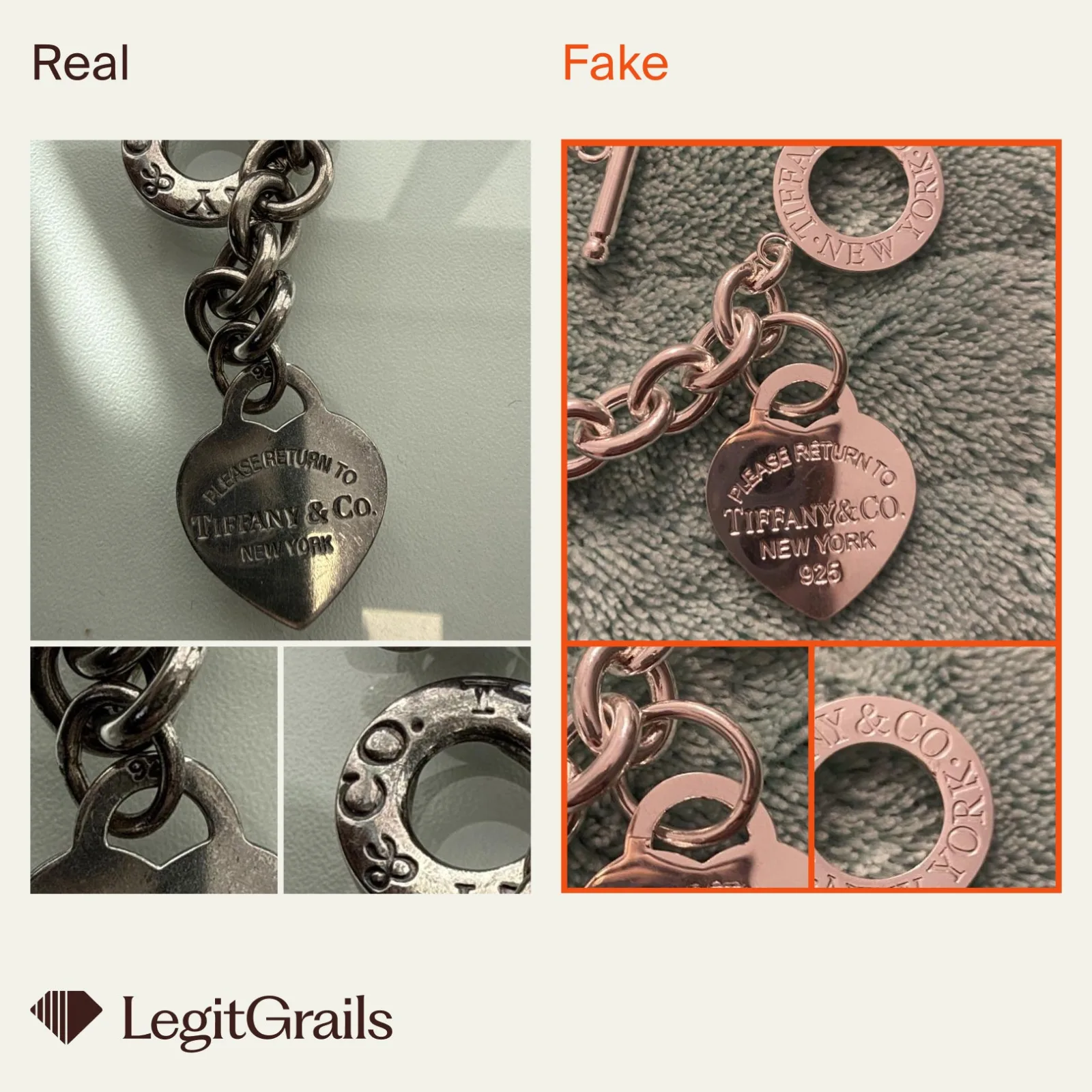
- **Link Gauge**: Authentic links are uniformly round and consistent in thickness throughout the chain. Counterfeits often have links that vary in thickness, with some visibly flatter than others.
- **Bail Formation**: On genuine pieces, the bail (the loop connecting the pendant to the chain) is an integral part of the tag, formed during casting. Counterfeits use a separate ring passed through a punched hole, which leaves a raised rim around the hole.
- **Tag Edge Profile**: The authentic tag has a rounded edge that flows smoothly from face to edge. Counterfeits have a flat edge with a sharp stamped rim and visible burrs.
These details reflect the precision engineering of authentic Tiffany craftsmanship versus the cost-cutting shortcuts used in fakes.
Toggle Ring and Clasp Quality: Attention to Detail
The toggle closure is another area where authenticity shines through.
- **Toggle Band Width**: The authentic toggle ring has a wide band relative to its aperture, allowing clear margins above and below the engraved letters. Counterfeits have narrower bands, causing the letters to run flush with the edges.
- **Quality Tag**: Located near the clasp, this small oval bar carries a marking such as '925' or 'Sterling'. On genuine pieces, the characters are upright, evenly spaced, and cut to the same depth. Counterfeits often mix uppercase and lowercase letters, slant the text, or vary the depth mid-string.
- **Bar Outline**: The authentic bar is a true elongated oval with fully rounded ends. Fakes tend to be narrower with squared shoulders where the curve should continue.
- **End Rings**: The authentic bar connects to the chain via small closed rings matching the chain gauge. Counterfeits may feature an oversized or visibly open ring at one end.
Pouch and Printed Card: Supporting Evidence Only
While not definitive proof, the pouch and card can provide additional context.
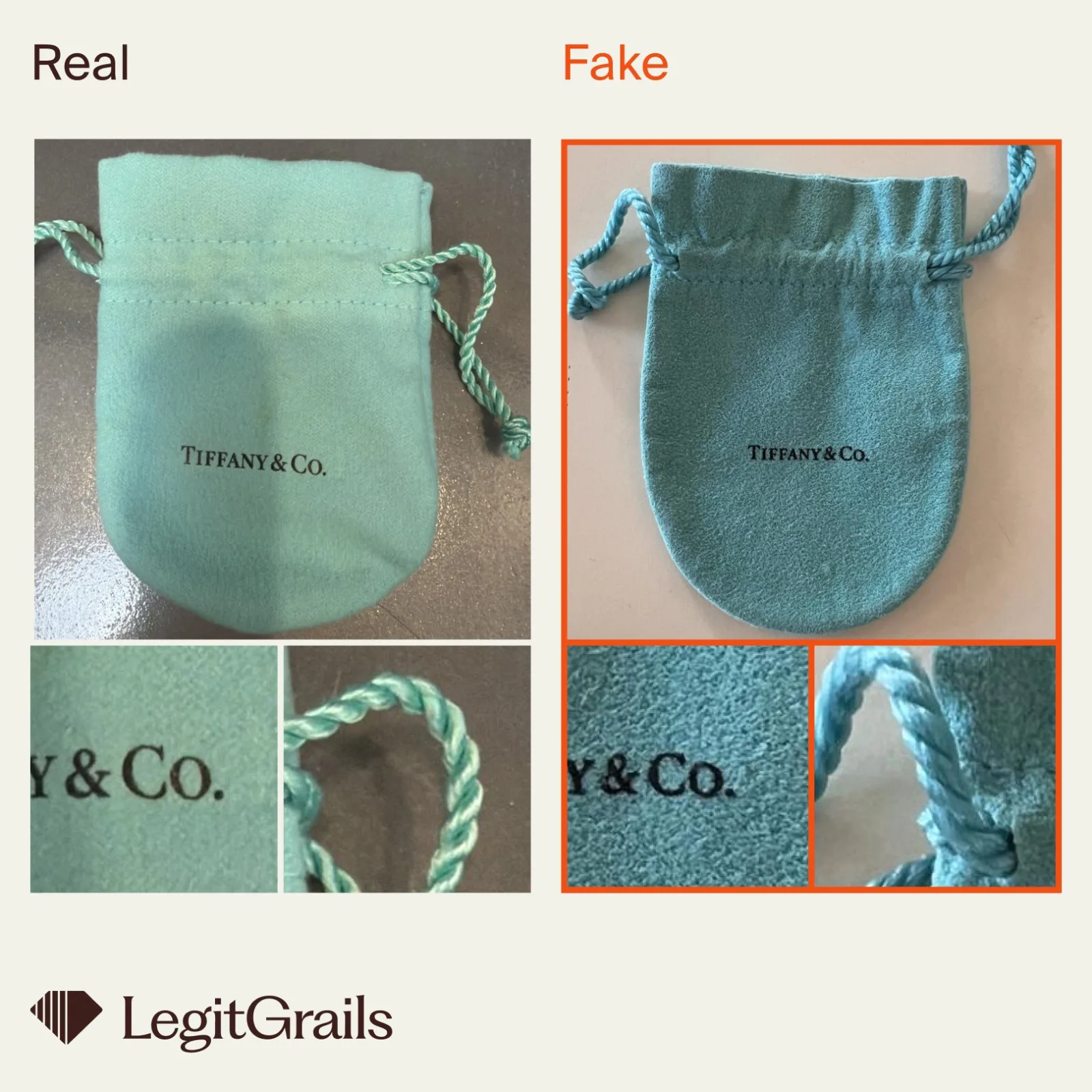
- **Pouch Shape**: The authentic pouch is nearly square with a shallow rounded base. Counterfeits are narrower at the top and finish in a deep, domed shape.
- **Drawstring Channel**: On genuine pieces, the channel is stitched well down from the top edge, leaving a flat band above. Fakes have the channel closer to the edge, causing pleats to form above it.
- **Cord Twist**: The authentic cord has a tight, even twist that holds its shape. Counterfeit cords are looser, with fibers lifting away from the twist.
- **Printed Card**: The card displays only the wordmark. It lacks serial numbers or signatures, so it cannot verify individual authenticity. However, the print quality differs: authentic cards show strong thick-to-thin transitions in the letterforms, while fakes have uniform strokes and ink spread at the edges.
Red Flags That End the Inspection
Certain flaws are so severe they immediately indicate a counterfeit:
- Missing curved top line on the heart tag
- Lettering that touches both ends of the signature plaque recess
- An open bent ring instead of a formed loop
- Characters that change depth mid-string
- Mixed letter cases in the quality tag
These issues suggest poor tooling or hand-finishing, which are hallmarks of mass-produced fakes.
What Current Counterfeits Get Right
Modern fakes often replicate the silhouette, toggle closure, signature plaque, and packaging accurately. At arm's length or in low-resolution photos, they can be indistinguishable. However, they consistently fail in areas requiring precision: consistent depth, proper margins, and clean stamping. Silhouette is easy to copy; repeatability is not.
What You Can Check Yourself
Three checks can be reliably performed using photographs:
1. Count the number of engraved lines on the heart tag (four total, including the arc)
2. Check whether the plaque lettering clears both ends of its recess
3. Confirm that any joining ring is closed, not open
Depth consistency, stroke quality, and metal tone require magnification and lighting control, making them less reliable in photos alone.
For further reading on luxury item authentication, consider our guides on How to Spot a Genuine Bottega Veneta Handbag vs. a Counterfeit or Cartier Tank vs. Santos: Which Classic Watch Fits Your Style?.
Frequently Asked Questions
How can I tell if my Return to Tiffany necklace is real based on the heart tag?
A genuine Return to Tiffany necklace has four lines on the heart tag: a curved line at the top and three centered lines below. The text sits on a straight baseline with even stroke depth. If the curved line is missing or the text is tilted and uneven, it is likely a counterfeit.
Why does the signature plaque on my necklace look crowded?
On authentic pieces, the lettering on the oval plaque sits clearly within the recess, leaving visible margins at both ends. If the letters touch the edges or merge together, it indicates a counterfeit.
Is the metal tone a reliable way to identify a fake Tiffany necklace?
No. Metal tone varies between finishes and can be misleading due to lighting. Focus instead on construction details like link uniformity, bail formation, and engraving precision.
What does the quality tag on the clasp say on a real necklace?
The quality tag typically reads '925' or 'Sterling', indicating sterling silver. On genuine pieces, the characters are upright, evenly spaced, and cut to the same depth. Counterfeits often mix letter cases or have inconsistent depth.
Can I trust the pouch and card that came with my necklace?
The pouch and card are not proof of authenticity. While they may match the original design, they are easily replicated. Use them as supporting evidence, but rely on physical details like engraving and construction for verification.
Does the absence of a serial number mean my necklace is fake?
Not necessarily. The Return to Tiffany necklace does not include a serial number. Authenticity is determined by construction and engraving quality, not paperwork.